Giornale Degli Orologi
Menu
Menu

Tag: Breguet

  • Classique Tourbillon Sidéral and Breguet’s double anniversary

    Classique Tourbillon Sidéral and Breguet’s double anniversary

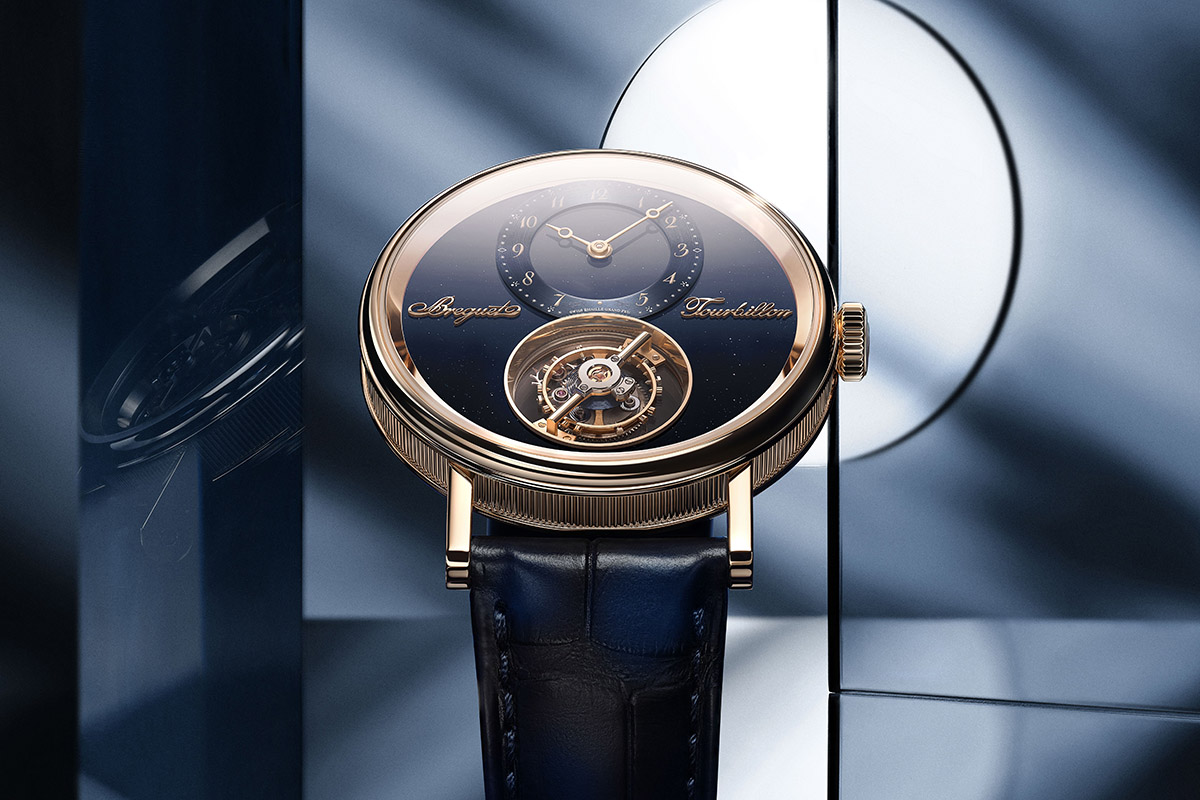
    On 26 June, Breguet unveiled the latest addition to its Classique collection: the Classique Tourbillon Sidéral 7255. This was no ordinary date, but the 224th anniversary of the patent for the ‘tourbillon regulator’. This was filed by Abraham-Louis Breguet on 26 June 1801 — or, rather, on the 7th Messidor of Year IX according to the then-in-force French Republican calendar. And not just any watch: it is the fourth timepiece launched by the Maison to celebrate its 250th anniversary, following the Type XX Chronograph 2075, the Tradition Seconde Rétrograde 7035, and the Classique Souscription (listed here in reverse order from most recent to oldest).

    So here comes the long-awaited tourbillon – the one everyone was expecting and speculating about. Although it likely won’t be the only one in this year of celebrations.

    But, beyond predictions for the future, the new Classique Tourbillon Sidéral is remarkable in the way it has been developed. In my opinion, it is not only beyond expectations, but also different from any other tourbillon produced so far by Breguet. I would describe it as striking, without any negative connotations. After all, it is a flying, mysterious and sidereal tourbillon. Let us try to understand what that means.

    The tourbillon…

    Everyone knows what a tourbillon is, but it’s always worth reminding ourselves what it actually is. Essentially, it is a mechanism designed to counteract errors and spatial variations in watch operation. The balance wheel‘s regularity is compromised by negative influences exerted by the force of gravity. This is particularly the case with pocket watches, which are usually kept in a vertical position. The problem lies in fine-tuning and perfectly balancing the tourbillon, which increases manufacturing costs.

    The tourbillon, which is inextricably linked to Abraham-Louis Breguet, was invented by him. Its principle consists of mounting the regulating organ (the entire escapement plus the balance wheel/spring system) on a mobile support. This support is technically called a cage and completes a rotation in a given period of time (usually one minute or more). The errors are therefore reproduced cyclically, cancelling each other out with each complete rotation. Tourbillon watches are therefore theoretically more accurate.

    …Flying

    Our readers should also be familiar with the concept of a flying tourbillon. This is not a device created by Abraham-Louis Breguet, but it is much more recent. It was invented in 1920 by Alfred Helwig, a German watchmaker who taught at the Glashütte watchmaking school. In practice, it is an evolution of the tourbillon, with the cage fixed only at the base on the plate.

    Free from the upper bridge, it provides an unobstructed view of its rotary motion, almost seeming to hover in the air — hence the term ‘flying’.

    However, this makes the manufacture of the tourbillon even more complex. The manufacturer must address issues of balance and the structure of the cage itself, which must be robust yet light and finely adjustable in any case. Ultimately, it is a display of virtuosity for mere aesthetic purposes.

    …mysterious and sidereal

    In watchmaking, the term ‘mysterious‘ is used to describe timepieces in which some of the key components remain hidden. The observer cannot understand how power is transmitted to the various parts when looking at it. A famous example is Cartier’s pendulettes mystérieuses, in which the hands appear to be floating in space. In reality, they are attached to a rock crystal disc, which is connected to the movement in the base via a well-hidden vertical axis.

    In Breguet’s Classique Tourbillon Sidéral 7255, however, the mystery relates to the tourbillon. Both the tourbillon cage bridge and the base to which it is attached are made of sapphire crystal and are made even more invisible by a surface coating. Since the connection to the time train is lateral to the tourbillon opening and hidden by the dial, the illusion of the tourbillon floating in the void is even more impressive.

    The final adjective, ‘sidereal’, which also appears in the name, recalls an astronomical context, as does the splendid aventurine enamel dial, which we will discuss later. As the official literature explains, the reference to the stars also has semantic value. In French, tourbillon means ‘whirlwind’ or ‘vortex’. It was the great philosopher and mathematician Blaise Pascal, who lived between 1623 and 1662, who defined it as a ‘physical structure animated by a revolving motion‘. Hence, by extension, the concept moved on to planetary systems and thus to the entire field of astronomy.

    The aesthetics of the Classique Tourbillon Sidéral 7255

    Well, after the introductory explanations, I will now proceed to describe the watch. Like the other anniversary pieces, the 38 mm Classique Tourbillon Sidéral 7255 has a case made of Breguet gold. This is an alloy composed of 75% gold, with the remaining 25% consisting of silver, copper and palladium. Warmer than yellow gold, yet more delicate in colour than red gold, its hue is inspired by the gold alloy used during the time of Abraham-Louis Breguet. It is thus a further tribute to the era of the Maison’s establishment.

    The observer is immediately struck by the beauty of the dial, which is a fragment of the night sky rendered using the traditional Grand Feu enamel technique. Although it resembles a thin slab of aventurine stone (a type of quartz containing mica inclusions), it is actually a disc made of Breguet gold coated with glass. According to legend, the name ‘aventurine’ comes from the fortuitous circumstances of its invention. It is said that, in 17th-century Venice, a Murano glassmaker accidentally dropped copper filings into the molten glass. The result was a type of glass resembling the starry night sky.

    The aventurine enamel dial

    In the dial of the Classique Tradition Sidéral 7255, aventurine glass is used instead of enamel in a lengthy and intricate handcrafted process comprising several steps. First, the glass is ground into a powder containing larger grains than usual. Next, the powder is mixed with water to form a paste, which is then applied by hand to the metal substrate using a small brush.

    The dial then undergoes a first passage in an oven at a temperature of over 800°C. This process is repeated up to five times until the desired colour intensity is achieved. Unfortunately, there are risks involved in each round, because firing the enamel is very critical and the final result cannot be taken for granted. If something goes wrong, the whole process has to be started again, as the dial has to be thrown away.

    The 187M1 Calibre

    Turning to the mechanics, the Classique Tradition Sidéral 7255 features a movement inspired by the Classique 3350, the first tourbillon wristwatch created by Breguet in 1988.

    It has the same manual winding and ‘full bridge’ architecture, as well as the same hand-crafted decoration. However, the new Calibre 187M1, which can be seen through the large sapphire crystal porthole on the caseback, features different guillochage. This is the custom-made Quai de l’Horloge motif created for the anniversary. Notice the tourbillon aperture on the back: the sapphire crystal surrounding the guilloché gold base makes the device look as if it is suspended in a vacuum.

    The movement design is also worth mentioning, as it is entirely focused on the tourbillon, which is further emphasised by its raised position. In fact, the tourbillon protrudes 2.2 mm from the plate and 0.9 mm from the dial. The tourbillon’s thickness reaches 7 mm, defining the volume of the entire movement and case, which is 10.2 mm thick.

    The main mechanical specifications can be found in the captions. However, it is worth mentioning at least two pieces of information. Firstly, the balance has a slow and constant frequency of 18,000 vibrations per hour, reminiscent of pocket watches of yesteryear. Secondly, the Nivachron™ balance spring is patented, antimagnetic and blued to make it stand out more inside the balance.

    Classique Tourbillon Sidéral: final considerations

    There is much more that could be said about the Classique Tourbillon Sidéral 7255, but I will stop here. The complexity of the movement and the challenges involved in manufacturing the dial mean that the Maison can only produce a limited number of pieces: just 50 for worldwide distribution. The exclusivity is also reflected in the price: 225,900 euros.

    This is one of those watches that really must be seen in person to be fully appreciated: to admire, touch and wear it is the only way to understand what haute horlogerie is all about. This limited edition means that, in the near future, each of the company’s boutiques globally will receive only a few pieces. However, Italians interested in buying the watch can contact the boutique at Via Montenapoleone 19 in Milan. The rest of us can only visit the official website. And gnaw…
  • Type XX Chronographe 2075: two flybacks for Breguet’s 250 years

    Type XX Chronographe 2075: two flybacks for Breguet’s 250 years

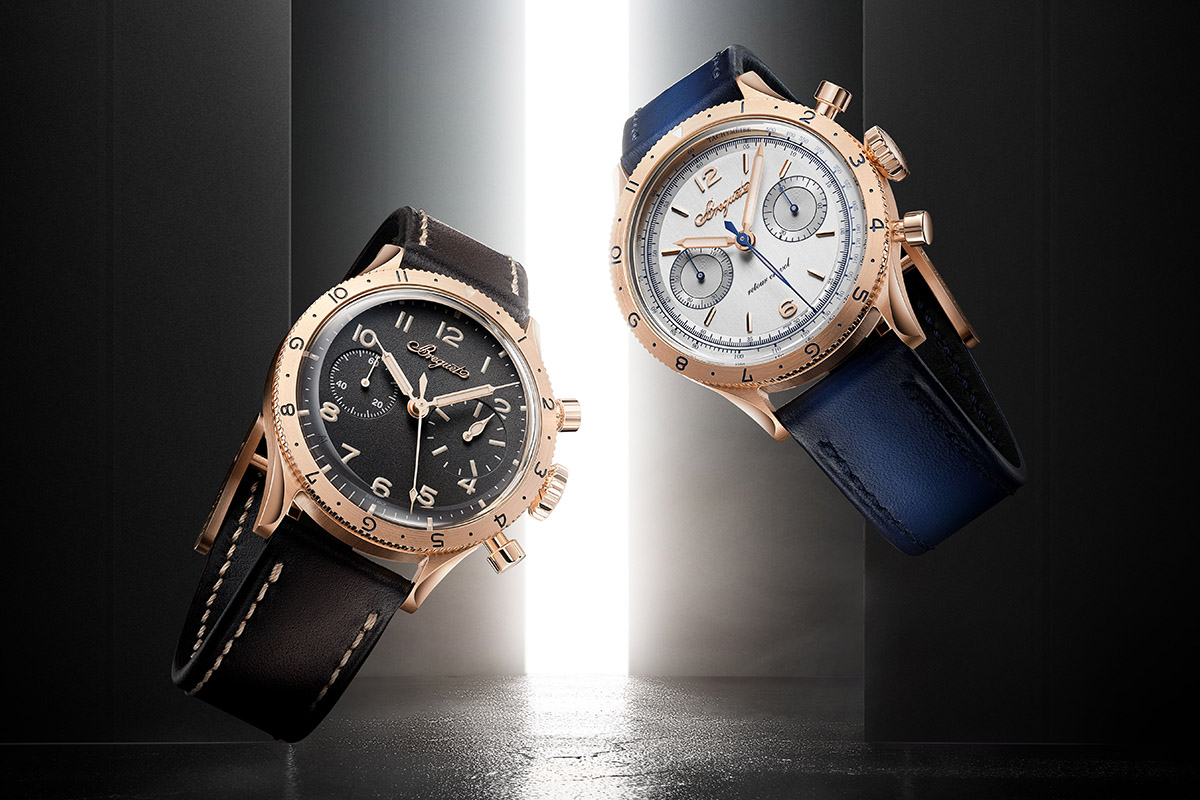
    2025 is set to be a landmark year for Breguet. This year is the Brand’s 250th anniversary. To mark the occasion, the catalogue is being expanded with celebratory models designed to retrace the major milestones in its history. The first is the Classique Souscription, which was first presented in Paris. After it comes the Tradition Seconde Rétrograde 7035, which was first presented in Shanghai. The third launch, in June, was held in New York and introduced two variants of the new Breguet Type XX Chronographe 2075 – the fifth generation of the homonimous line created in the early 1950s.
    Both chronographs boast a flyback function and draw clear inspiration from the 2023 collection, showcasing significant advancements in materials, calibres and case diameters. The two new references differ in their dials, in the chronograph minute counter at 3 o’clock and, albeit slightly, in the hand-wound mechanical movement.

    Breguet and flight: more than just a commercial relationship

    Both watches are inspired by aviation. The Swiss company’s link with air travel is well known – and not simply commercial. Just as Abraham-Louis Breguet made an everlasting mark on the realm of horology, his nephew Louis Charles Breguet (1880-1955) did the same for aviation. He founded Breguet Aviation in 1911, a company that produced avant-garde biplanes and monoplanes. One of these planes was the Breguet 19, a reconnaissance bomber used for long-distance flights.

    Two French aviators, Dieudonné Costes and Maurice Bellonte, in 1930 used this plane to cross the Atlantic and fly the Paris-New York route non-stop. This was a feat in response to Charles Lindbergh’s solo crossing three years earlier on the same route but in the opposite direction. Keep this in mind because we will return to it later.

    The company’s production capacity is demonstrated by the production of  55,000 aircraft for the French Air Force during the First World War. Breguet’s proposal for the Type XX in the early 1950s was for the same aviation. Four generations of Type XX – presented between 1971 and 2023 – have led us to the present day and to the models that I am going to describe in more detail.

    The aesthetics of the Type XX Chronographe 2075

    Reference 2075BH/99/398, the first of the two new references, bears a strong resemblance to the 1955 Type XX. The timepiece features a black dial on anodised aluminium, or more specifically, Duralumin, a hardened aluminium alloy. Special features are a 15-minute chronograph counter at 3 o’clock, which is larger than the seconds counter at 9 o’clock, and its leaf-shaped hand. I consider the “big-eye” 15-minute dial with its differently shaped hand to be very effective aesthetic elements.

    The second watch, Reference 2075BH/G9/398, is a limited edition of 250 pieces (numbered on the back bezel). The timepiece features a brushed silver dial, with symmetrical and equally sized small seconds and 30-minute chronograph counters (instead of 15). At 6 o’clock, the italicised inscription “retour en vol” (meaning “return to flight”) highlights its specific function, while the tachometer scale on the flange refers to the speed calculation.

    Both models boast a Breguet gold case, pushpieces, hands and pin buckle, an 18-carat gold alloy developed specially by the House of L’Abbaye to celebrate its 250th anniversary. In addition to gold, which constitutes 75% of the alloy, Breguet gold also contains silver, copper and palladium. The result is a unique metallic lustre and colouring.

    Both have a 38.5 mm-diameter case, which confirms the current trend towards narrower designs. This will benefit both men with slim wrists and women attracted to military-style chronographs. The crown is not screwed down, which explains the limited water resistance: the models have both a 5 bar pressure rating. For more information about the aesthetic and construction elements, please refer to the captions accompanying the image gallery above.

    The Breguet Type XX Chronographe 2075 and calibres 7279 & 7278

    Now let’s look at the two calibres housed inside the case, which is 13.2 mm thick in both timepieces. The movements are derived from the Breguet 728, launched in 2023 and differ from each other by a single component. The 7279 calibre of the model with the black dial contains 258 components, while the 7278 calibre of the model with the silver dial contains only 257. It is clear that this relates to the different counting of the chrono minute counter.

    In terms of appearance, they are almost identical, with both models featuring decorations and hand-made engravings, created in the Manufacture’s workshops, visible through the sapphire crystal on the case back. To be precise, they are the Breguet 19 reconnaissance bomber that was mentioned earlier, the flight path followed from Europe to America, and part of the two continents’ coastlines. In terms of craftsmanship and creative ability, Breguet has very little to learn.

    The technical point of view

    As I mentioned in the introduction, both calibres are hand-wound, which, in my opinion, enhances their appeal. Both models are equipped with the flyback function, a highly essential complication for a watch designed for pilots, given its introduction over half a century ago.
    The flyback function, which can be activated by pressing the pusher at 4 o’clock, allows the chronograph to be reset to zero and restarted instantly. This is made possible thanks to the column wheel, which is visible when observing the movement on the back side.

    Although this sophisticated complication is difficult to implement, it is extremely useful.
    It makes it possible to measure partial time intervals without stopping, resetting and restarting the chronograph. Finally, I would like to make reference to the (high) operating frequency of 5 Hz, equal to 36,000 vibrations per hour. This technical solution guarantees seamless movement of the seconds hand and outstanding chronograph precision.

    Final considerations and prices

    We don’t know what other surprises Breguet has in store for 2025. We have seen the launch of models of unquestionable value, combining history, tradition and the ability to reinterpret both in a contemporary key. A further confirmation are the two Breguet Type XX Chronographe 2075, crafted with ‘noble’ materials (Breguet gold, aluminium and silver) and equipped with the flyback complication.

    Their prices are therefore in line with the Brand, the quality of the craftsmanship and the prestige that the Type XX collection has kept unchanged for 70 years. The Type XX Chronographe 2075 with black dial is priced at €43,400, while the model with silver dial is priced at 45,200 euro. The slight price increase of the latter is fully justified by the change in dial material and the increasing collector value that limited edition watches can acquire over time.

  • Tradition Seconde Rétrograde 7035, Breguet continues to celebrate

    Tradition Seconde Rétrograde 7035, Breguet continues to celebrate

    The 250th anniversary is an important milestone. To mark the occasion, Breguet is launching a series of anniversary-dedicated timepieces throughout 2025. The first of these was the Classique Souscription, unveiled last month. Next is the Tradition Seconde Rétrograde 7035, which, as we shall see, is the perfect follow-up to the previous model. It is reasonable to assume that all of the celebratory watches released will retrace the history of the House. They will pay tribute to Abraham-Louis Breguet and his inventions, as well as to the company’s more recent history. This will be done in stages, in a logical order rather than chronologically. At least, that is my perception.

    The Tradition collection

    The Tradition collection, launched 20 years ago, draws inspiration from ‘subscription watches‘, just like the Classique Souscription. These pocket watches had a simple design with no complications. They were built by the Master in the 1790s and offered in 1796 alongside a promotional leaflet. This explained the pre-sale system involving advance payment. Then, in 1799, the same mechanical construction was used for ‘touch watches‘, also known as montres-à-tact. These watches allowed the wearer to read the time by touching an arrow hand positioned outside the case and the hour markers on its rim.

    Combining elements of these two historical types, the Tradition collection has been instantly recognisable since its inception thanks to its unique design. This design shifts the display of hours and minutes to an off-centre dial, revealing the main components of the movement. The first model, released in 2005, featured a yellow gold case and a hand-wound mechanical movement with a power reserve display (Ref. 7027). The following year, it was released with a white gold case and an automatic movement featuring the same minor complication (Ref. 7037). Thus, the collection immediately demonstrated its ability to evolve, acquiring various functions over the years. We now have a Tradition model with a dual time zone, a tourbillon, a chronograph and a retrograde date display.

    Tradition Seconde Rétrograde: two models compared

    Reference 7097 dates from 2015 and is still in production today. This timepiece features a retrograde seconds hand and is considered the predecessor to the current Tradition Seconde Rétrograde 7035. The two models differ in several ways, beginning with the case. While the 7097 is made of white gold and has a diameter of 40 mm, the 7035 is made of Breguet gold and has a diameter of 38 mm. This exclusive alloy, developed for the 250^(th) anniversary, was first featured in the Classique Souscription. It is composed of 75% gold and 25% silver, copper, and palladium.

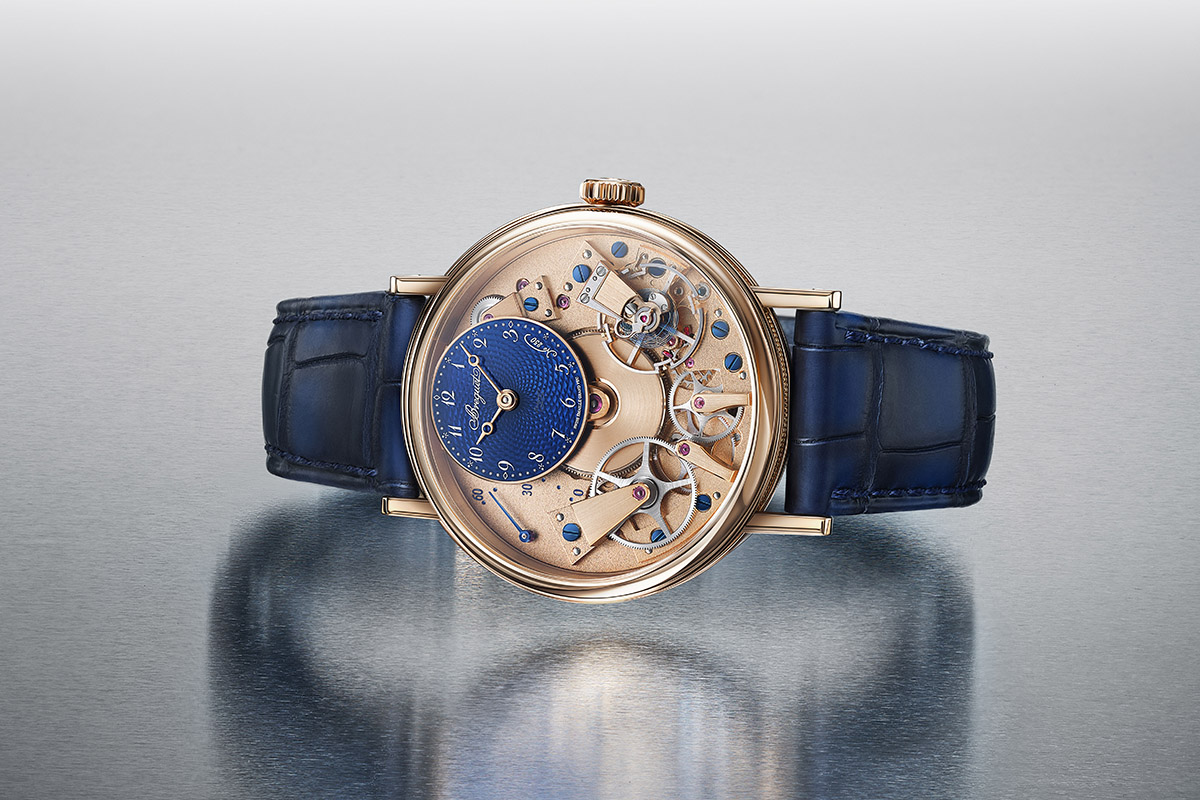
    The off-centre dial is also different: in Ref. 7097, it is silver-plated gold with a hand-decorated Clou de Paris guilloché pattern. Ref. 7035, on the other hand, features personalised Quai de l’Horloge guillochage, paying homage to the Parisian street on which the founder’s atelier was located when it opened on the Île de la Cité in 1775. According to the company, this motif is inspired by the arms of the Seine, as depicted on the famous 18th century Plan de Turgot map of the city, which is now on display at the Louvre. Commissioned by Michel-Etienne Turgot (1690–1751), Head of the Paris Municipality, it was created by the master engraver Louis de Bretez, and is today considered one of the most beautiful maps of Paris ever made.

    Breguet’s distinctive details

    It should also be noted that guillochage is one of the crafts that Maison Breguet is most proud of. The dial of the Tradition Seconde Rétrograde 7035 is not only finely hand-engraved, but also coated with translucent blue Grand Feu enamel. This is Breguet blue, of course: the distinctive shade that sets the brand’s timepieces apart and has become one of its most iconic design features. Here, the underlying carving gives it lighter and deeper reflections. This blue also colours the thin retrograde seconds hand at 10 o’clock. It also tints the movement screws, which are made of flame-blued steel in accordance with the finest watchmaking tradition.

    The 505SR calibre

    In terms of mechanics, the new Tradition Seconde Rétrograde 7035 shares its movement with the Ref. 7097: Calibre 505SR. The oscillating weight for the automatic winding is distinctive in its unusual shield or half-moon shape, as defined in the official press release. This is a legacy of the ‘perpetual’ calibre invented by Abraham-Louis Breguet, the precursor to modern self-winding watches. In ref. 7097, the oscillating weight is made of gold; in ref. 7035, it is made of platinum, a high-density metal that optimises performance. Most notably, the latest-generation 505SR calibre features plates and bridges that are entirely made of Breguet gold. While the grenaillé finish on the main plate was present on the previous model, the bridges and barrel cover are brushed in this latest version.

    Another difference is the anti-magnetic balance spring: while it is made of silicon in the 7097 (like the anchor’s horns, with their inverted construction), it is made of Nivachron™ in the 7035. This choice is undoubtedly influenced by the progress of research (the Nivachron™ spiral is a recent invention). However, it is also most likely due to the desire to use traditional materials, such as the ‘good old metal’, as Augusto Veroni would say. The titanium base of the Nivachron™ balance spring overcomes the uncertainties posed by silicon for the future. It is by far the better choice for a watch with eternal ambitions, such as this anniversary model.

    The latest details of the Tradition Seconde Rétrograde 7035

    As always, I will conclude with the retail price. The Tradition Seconde Rétrograde 7035 costs €51,200, compared to €43,300 for the reference model, 7097. This price difference reflects the increased amount of gold, the presence of platinum and Grand Feu enamel, and everything I have described above. The packaging is also worth mentioning: it is a red leather case similar to that of the Classique Souscription. Drawing inspiration from Moroccan boxes from the Breguet era, it is sure to be a defining feature of the anniversary models.