Giornale Degli Orologi

Tag: dress watch

  • SP One: MB&F wears classicism (in its own way)

    SP One: MB&F wears classicism (in its own way)

    When I received the press kit for MB&F’s new SP One, I was reminded of something the brand’s founder, Maximilian Büsser, said during a chat we had last year. “Another idea that I will never change is to not be influenced by the market. I don’t think I have ever created something similar to what someone else has done. If someone had already made it, there was no reason for us to make it too”. That is exactly the essence of this watch.

    SP One, a bridge between collections

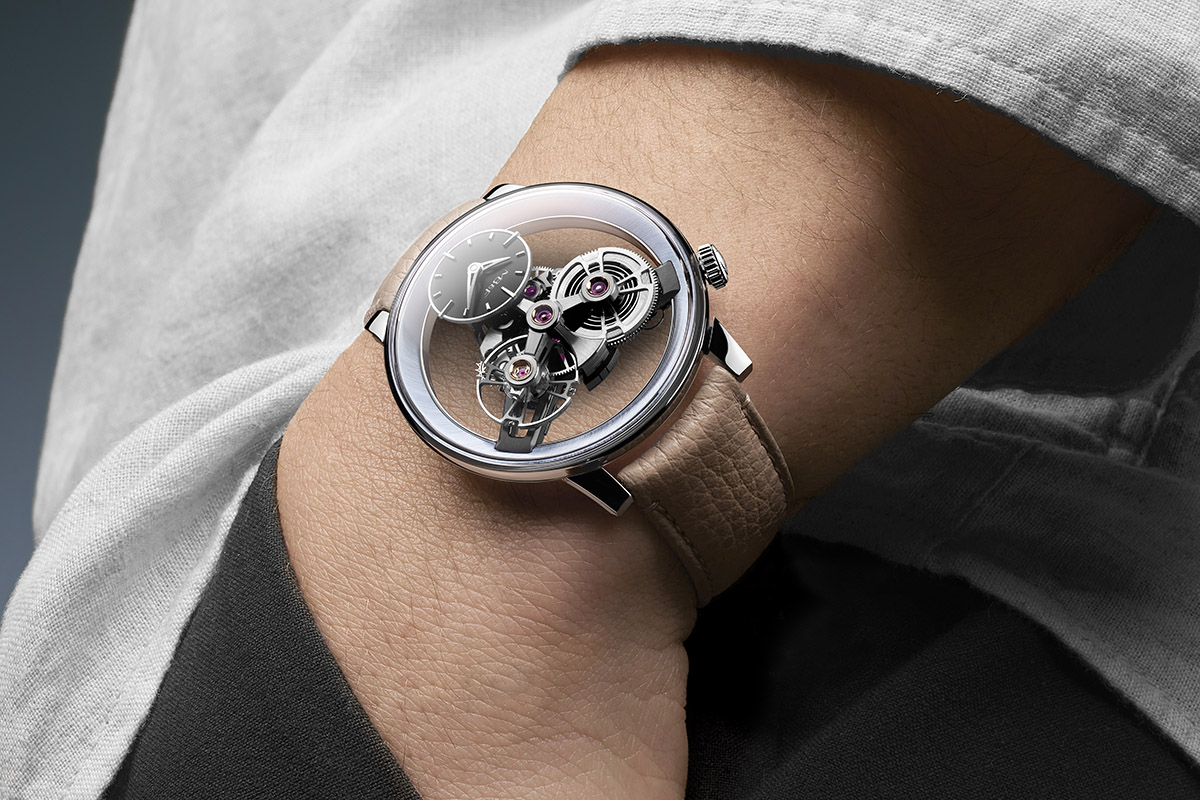
    Like most pieces from the Büsser manufacture, the SP One is all about transparency. The movement appears to be suspended in a bubble between the domed sapphire crystal protecting it and the flat sapphire crystal on the back. The eye passes unhindered through the entire structure of the watch, gliding through the calibre, which is far from inconspicuous.

    Elegant yet avant-garde, the SP One is the first model in a new Special Project collection that encapsulates the brand’s contemporary aesthetic in a smaller, wearable format. Horological Machines tend to be futuristic, featuring visionary movement architecture and large, structured cases. Legacy Machines, on the other hand, interpret vintage pocket watches, incorporating features such as blued steel hands and a traditional movement layout.

    In a sense, the SP One reconciles these two philosophies by offering a contemporary design in more conventional sizes and shapes. The round, smooth case (MB&F liken it to a river pebble) and choice of materials − platinum or rose gold − are both traditional. However, inside, the movement is reminiscent of a Horological Machine, to the extent that the case and precious materials almost seem to disappear. It appears to be ‘swallowed up’ by the light and transparency of the two sapphire crystals, which it essentially only serves to support.

    The ‘three tenors’

    Three circular elements of the movement stand out: the barrel, the balance and the dial. After all, the SP One calibre was initially named ‘Three Circles’ for a reason. This is nothing new for MB&F in terms of movement skeletonisation. The design and engineering solutions have now made it possible to exploit the conical gears and inclined dial. These two hallmarks of MB&F’s work come together to create an almost pyramidal calibre, with the central ruby serving as the apex.

    The SP One calibre’s Y-shaped architecture was developed in-house by the MB&F team from the initial concept to the final design. The vertices of the Y form the three points at which the movement bridges anchor to the case flange. Each one gives substance to the element it supports: the barrel, the balance and the dial. As I wrote earlier, the movement appears to be ‘suspended’ in a bubble, even though it is not. In fact, the bridges are firmly attached to the overall structure of the watch.

    MB&F’s signature sloping dial at the 6 o’clock position features a Dlc-coated base and classic polished hour markers and hands. The barrel and balance wheel are arranged symmetrically at the top of the watch. The SP One’s calibre has no visible bridges, screws or wheels, which adds to its elegance. All three elements have identical circumferences to enhance the overall architectural and aesthetic appearance. The flange features a spiral satin-finished surface that adds texture to the entire structure. Depending on the case material, the flange is either blue for platinum or anthracite for pink gold.

    The case of the SP One

    This can also be said of the case, although personally, I find it hard to call it such, given the prominence of the sapphire in this watch. The overall thickness is 12 mm, and beyond the convexity and softness of the shapes, it is the architecture of the lugs that stands out. As it is not possible to attach them to the front of the case, the MB&F designers have elegantly integrated them into the case back.

    While the SP One is at its best when viewed from the front, its architecture is impressive from any angle. The bridges, which are almost invisible from the side of the dial, can be seen peeping through the time train. The scene is stolen by the precise angling of the elements. This is done strictly by hand. Together with the satin-finished, polished and micro-blasted surfaces, this gives the entire movement a balanced appearance.

    As I wrote, the case is available in either rose gold or platinum and has a fully polished finish, making it rather discreet. The only original features are the crown at 10 o’clock and the slight floating effect on the lugs. This was probably the intention of Max Büsser and his team when they created the SP One. The lack of a bezel adds to the sense of transparency and lightness without making the watch appear smaller. This, I imagine, makes it uniquely comfortable to wear, along with its soft shape.

    Taking a look at the market

    I have left room in the captions for further technical details and additional information about the watch. Finally, I will simply remind you of the prices: 67,100 euro for the platinum model and 61,780 euro for the pink gold model, both excluding VAT. And one final thought.

    From what I can see in the press kit, the watch encapsulates everything I like about MB&F: the over-the-top ‘exposed’ mechanics, the futuristic design and the touch of classicism. I appreciate that it doesn’t have what I don’t like about the brand, namely the complicated fit. Perhaps Büsser has ultimately been influenced by the market to some extent, despite what he says. Ultimately, this is not necessarily a bad thing.

  • Calatrava 8 Days Ref. 5328G: Patek Philippe’s formal watch adapted for use as a field watch

    Calatrava 8 Days Ref. 5328G: Patek Philippe’s formal watch adapted for use as a field watch

    One of the many features that sets Patek Philippe apart is its ability to evolve and develop while staying true to its historical identity. This is no easy feat, particularly with regard to the Calatrava collection. For a collection that is universally recognised by enthusiasts as the pinnacle of classicism, adapting to the times, tastes and the changing needs of modern life is hard work. Examples like the Calatrava 8-day ref. 5328G, which I saw and tried on at Watches and Wonders, prove that it’s challenging, but necessary. With this watch, Patek Philippe has done precisely that.

    When I observed the watch through the lens and put it on my wrist, I had the strange impression that I was wearing a field watch rather than a dress watch. This impression was shared by other colleagues, including those from abroad. That is, a ‘field’ watch designed for military use. In fact, it is arguably the most expensive field watch on the market. It is unlikely that Patek Philippe intended to give this nuance to the Calatrava in question. Yet something remains…

    Calatrava 8 Days 2.0

    This is probably because Patek Philippe has been reworking the design of the Calatrava collection subtly and intelligently over the past few years. The aim is to ensure that it does not become mired in tradition and lose its relevance, while still maintaining its identity. Examples of this include the expansion of dial finishes, more pronounced shapes (particularly in the lugs), and the use of the Clous de Paris finish along the case middle.

    All these elements are present and well amalgamated in the Calatrava 8-day ref. 5328G. This proves that the Geneva-based Maison has no intention of standing still with this collection — quite the contrary. In order to update the collection and make it more appealing to new enthusiasts, Patek Philippe incorporates technical solutions and design elements from its past without hesitation. In this case, it is the eight-day power reserve.

    The autonomy of the Patek Philippe calibres

    This long autonomy is a feature already found in some perpetual calendar table clocks from the 1920s, which were equipped with an eight-day power reserve. More recently, the Maison produced the Ref. 5100 10 Days, introduced in 2000. This model features a rectangular case and was produced in limited quantities of three thousand. This was the world’s first chronometer wristwatch with a 240-hour power reserve.

    Another example is the Ref. 5101P 10 Days Tourbillon, released in 2003, is a platinum timepiece with an Art Deco-inspired rectangular case and a bespoke hand-wound movement. Ten years later came the Ref. 5200 Gondolo 8 Days, Day & Date Indication. Its rectangular, hand-wound calibre and instantaneous weekday and date changes bear close relation to the reference I am writing about today. We shall see later.

    I recognise this face…

    I’m reminded of the feeling I wrote about previously when looking at that field watch. This feeling mainly comes from the structure of the dial. As with all my articles, I prefer to leave the strictly technical details to the captions. However, I think it is necessary to mention here that the Calatrava 8-day ref. 5328G looks like.

    The smoky blue dial features an asphalt-like texture, a familiar sight for Patek Philippe enthusiasts. We first saw this texture on a brown dial in ref. 5226G, introduced in 2022. Alongside this finish, the Calatrava 8-day ref. 5328G retains the design of the syringe hands and Arabic numerals from its predecessor, giving it the serious appearance of a field watch. Robustness and clarity of information reading are essential characteristics of this type of watch. For this reason, I think the dial is well designed.

    Eight carefree days!

    However, I mustn’t forget that a field watch should also be reliable and autonomous. With this in mind, before we return to the technical specifications, I would like to mention a historical detail regarding the calibre of the Calatrava 8 Days Ref. 5328G.

    As is often the case with Patek Philippe movements, it has a code that is almost impossible to remember – 31-505 8J PS IRM CI J – but it has solid roots in the company’s past. In fact, it relates to the Ref. 5200 Gondolo 8 Days, Day & Date Indication that I wrote about above, as they share the same basic movement structure. The main difference is that the 28-20 REC 8J PS IRM C J calibre was rectangular, to match the shape of the case. The current one is round, to fit perfectly into the Calatrava-style case.

    The eight-day autonomy is indicated by the ‘8J’ in the movement’s name and includes the functional features typically expected from a Patek Philippe field watch. These include the instantaneous change of the day of the week and the month, as well as the power reserve, which formally lasts eight days, but in reality lasts nine. This extra day is indicated by a red zone on the autonomy indicator.

    An 8-day Calatrava for all days

    Now, let’s move on to the captions. Not before recalling the price of the Calatrava 8-Day Ref. 5328G – €71,280 – and making a few final remarks about the watch. Patek Philippe unveiled it at Watches and Wonders alongside another Calatrava reference, the 6169P, which has a platinum case and an elegant, classic design. In my opinion, this was a smart move.

    While the platinum watch is undoubtedly a dress watch, more suited to special occasions than everyday wear, the Calatrava 8-Day Ref. 5328G is the perfect everyday watch. You can rely on it to keep the correct time and date when you put it on your wrist, even if you only wear it a few days a week. In this way, the Maison has offered an alternative within the same collection to satisfy the different tastes and needs of enthusiasts. Without altering it, as I wrote in the opening lines. This is why the Calatrava 8-day ref. 5328G is one of the few haute horlogerie pieces that is more than the sum of its parts today. In this respect, it is very Patek Philippe.