On 26 June, Breguet unveiled the latest addition to its Classique collection: the Classique Tourbillon Sidéral 7255. This was no ordinary date, but the 224th anniversary of the patent for the ‘tourbillon regulator’. This was filed by Abraham-Louis Breguet on 26 June 1801 — or, rather, on the 7th Messidor of Year IX according to the then-in-force French Republican calendar. And not just any watch: it is the fourth timepiece launched by the Maison to celebrate its 250th anniversary, following the Type XX Chronograph 2075, the Tradition Seconde Rétrograde 7035, and the Classique Souscription (listed here in reverse order from most recent to oldest).
So here comes the long-awaited tourbillon – the one everyone was expecting and speculating about. Although it likely won’t be the only one in this year of celebrations.
But, beyond predictions for the future, the new Classique Tourbillon Sidéral is remarkable in the way it has been developed. In my opinion, it is not only beyond expectations, but also different from any other tourbillon produced so far by Breguet. I would describe it as striking, without any negative connotations. After all, it is a flying, mysterious and sidereal tourbillon. Let us try to understand what that means.
The tourbillon…
Everyone knows what a tourbillon is, but it’s always worth reminding ourselves what it actually is. Essentially, it is a mechanism designed to counteract errors and spatial variations in watch operation. The balance wheel‘s regularity is compromised by negative influences exerted by the force of gravity. This is particularly the case with pocket watches, which are usually kept in a vertical position. The problem lies in fine-tuning and perfectly balancing the tourbillon, which increases manufacturing costs.
The tourbillon, which is inextricably linked to Abraham-Louis Breguet, was invented by him. Its principle consists of mounting the regulating organ (the entire escapement plus the balance wheel/spring system) on a mobile support. This support is technically called a cage and completes a rotation in a given period of time (usually one minute or more). The errors are therefore reproduced cyclically, cancelling each other out with each complete rotation. Tourbillon watches are therefore theoretically more accurate.
…Flying
Our readers should also be familiar with the concept of a flying tourbillon. This is not a device created by Abraham-Louis Breguet, but it is much more recent. It was invented in 1920 by Alfred Helwig, a German watchmaker who taught at the Glashütte watchmaking school. In practice, it is an evolution of the tourbillon, with the cage fixed only at the base on the plate.
Free from the upper bridge, it provides an unobstructed view of its rotary motion, almost seeming to hover in the air — hence the term ‘flying’.
However, this makes the manufacture of the tourbillon even more complex. The manufacturer must address issues of balance and the structure of the cage itself, which must be robust yet light and finely adjustable in any case. Ultimately, it is a display of virtuosity for mere aesthetic purposes.
…mysterious and sidereal
In watchmaking, the term ‘mysterious‘ is used to describe timepieces in which some of the key components remain hidden. The observer cannot understand how power is transmitted to the various parts when looking at it. A famous example is Cartier’s pendulettes mystérieuses, in which the hands appear to be floating in space. In reality, they are attached to a rock crystal disc, which is connected to the movement in the base via a well-hidden vertical axis.
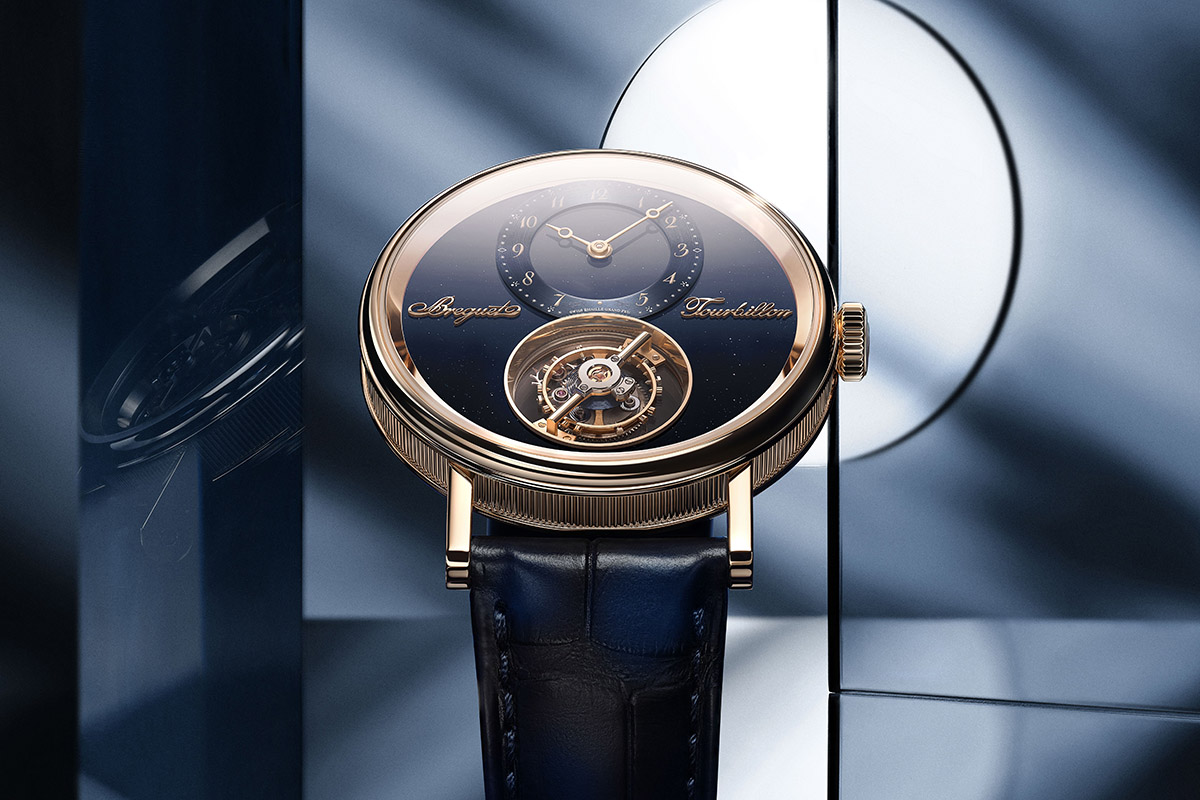
In Breguet’s Classique Tourbillon Sidéral 7255, however, the mystery relates to the tourbillon. Both the tourbillon cage bridge and the base to which it is attached are made of sapphire crystal and are made even more invisible by a surface coating. Since the connection to the time train is lateral to the tourbillon opening and hidden by the dial, the illusion of the tourbillon floating in the void is even more impressive.
The final adjective, ‘sidereal’, which also appears in the name, recalls an astronomical context, as does the splendid aventurine enamel dial, which we will discuss later. As the official literature explains, the reference to the stars also has semantic value. In French, tourbillon means ‘whirlwind’ or ‘vortex’. It was the great philosopher and mathematician Blaise Pascal, who lived between 1623 and 1662, who defined it as a ‘physical structure animated by a revolving motion‘. Hence, by extension, the concept moved on to planetary systems and thus to the entire field of astronomy.
The aesthetics of the Classique Tourbillon Sidéral 7255
Well, after the introductory explanations, I will now proceed to describe the watch. Like the other anniversary pieces, the 38 mm Classique Tourbillon Sidéral 7255 has a case made of Breguet gold. This is an alloy composed of 75% gold, with the remaining 25% consisting of silver, copper and palladium. Warmer than yellow gold, yet more delicate in colour than red gold, its hue is inspired by the gold alloy used during the time of Abraham-Louis Breguet. It is thus a further tribute to the era of the Maison’s establishment.
The observer is immediately struck by the beauty of the dial, which is a fragment of the night sky rendered using the traditional Grand Feu enamel technique. Although it resembles a thin slab of aventurine stone (a type of quartz containing mica inclusions), it is actually a disc made of Breguet gold coated with glass. According to legend, the name ‘aventurine’ comes from the fortuitous circumstances of its invention. It is said that, in 17th-century Venice, a Murano glassmaker accidentally dropped copper filings into the molten glass. The result was a type of glass resembling the starry night sky.
The aventurine enamel dial
In the dial of the Classique Tradition Sidéral 7255, aventurine glass is used instead of enamel in a lengthy and intricate handcrafted process comprising several steps. First, the glass is ground into a powder containing larger grains than usual. Next, the powder is mixed with water to form a paste, which is then applied by hand to the metal substrate using a small brush.
The dial then undergoes a first passage in an oven at a temperature of over 800°C. This process is repeated up to five times until the desired colour intensity is achieved. Unfortunately, there are risks involved in each round, because firing the enamel is very critical and the final result cannot be taken for granted. If something goes wrong, the whole process has to be started again, as the dial has to be thrown away.
The 187M1 Calibre
Turning to the mechanics, the Classique Tradition Sidéral 7255 features a movement inspired by the Classique 3350, the first tourbillon wristwatch created by Breguet in 1988.
It has the same manual winding and ‘full bridge’ architecture, as well as the same hand-crafted decoration. However, the new Calibre 187M1, which can be seen through the large sapphire crystal porthole on the caseback, features different guillochage. This is the custom-made Quai de l’Horloge motif created for the anniversary. Notice the tourbillon aperture on the back: the sapphire crystal surrounding the guilloché gold base makes the device look as if it is suspended in a vacuum.
The movement design is also worth mentioning, as it is entirely focused on the tourbillon, which is further emphasised by its raised position. In fact, the tourbillon protrudes 2.2 mm from the plate and 0.9 mm from the dial. The tourbillon’s thickness reaches 7 mm, defining the volume of the entire movement and case, which is 10.2 mm thick.
The main mechanical specifications can be found in the captions. However, it is worth mentioning at least two pieces of information. Firstly, the balance has a slow and constant frequency of 18,000 vibrations per hour, reminiscent of pocket watches of yesteryear. Secondly, the Nivachron™ balance spring is patented, antimagnetic and blued to make it stand out more inside the balance.
Classique Tourbillon Sidéral: final considerations
There is much more that could be said about the Classique Tourbillon Sidéral 7255, but I will stop here. The complexity of the movement and the challenges involved in manufacturing the dial mean that the Maison can only produce a limited number of pieces: just 50 for worldwide distribution. The exclusivity is also reflected in the price: 225,900 euros.
This is one of those watches that really must be seen in person to be fully appreciated: to admire, touch and wear it is the only way to understand what haute horlogerie is all about. This limited edition means that, in the near future, each of the company’s boutiques globally will receive only a few pieces. However, Italians interested in buying the watch can contact the boutique at Via Montenapoleone 19 in Milan. The rest of us can only visit the official website. And gnaw…