Giornale Degli Orologi

Tag: Patek Philippe

  • Patek Philippe 5320G-011: the Perpetual Calendar Turns 100

    Patek Philippe 5320G-011: the Perpetual Calendar Turns 100

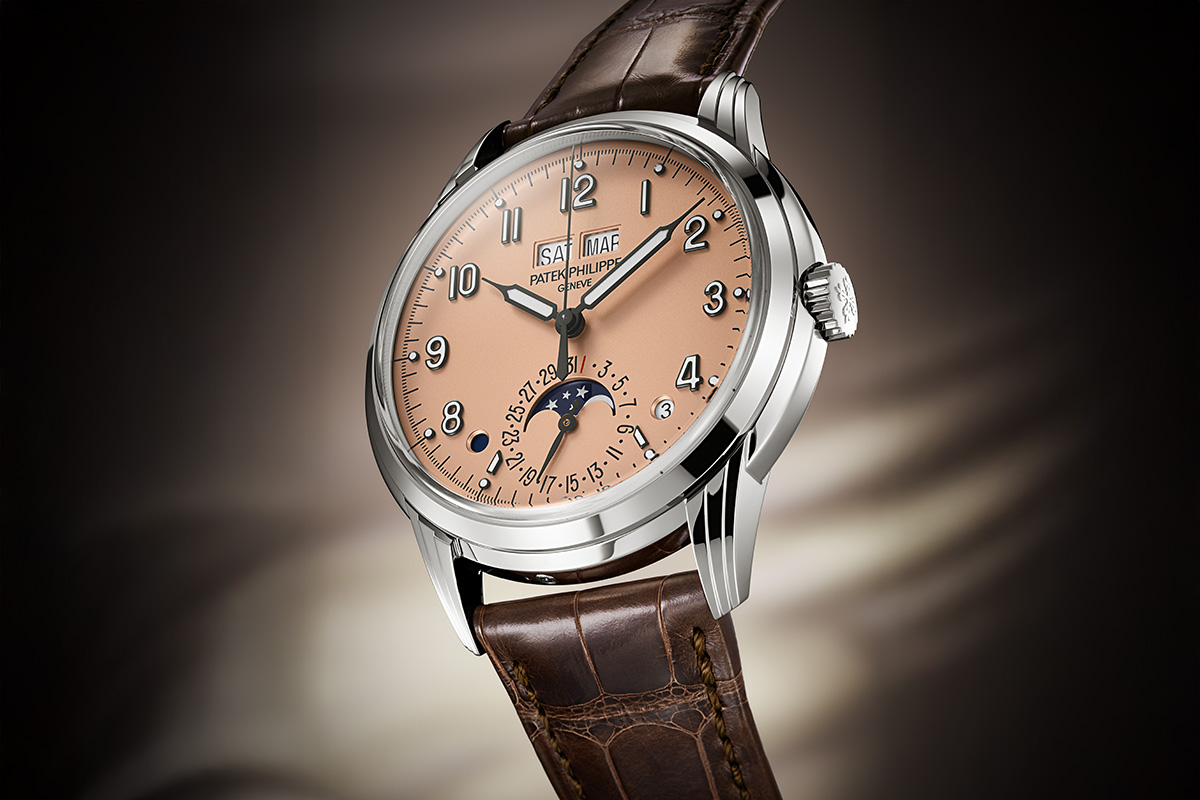
    2025 is a significant year for Patek Philippe, the world of watchmaking and watch enthusiasts alike. In 1925, the Geneva-based Maison introduced its first wristwatch with a perpetual calendar: the Reference 97975. Note the use of the term ‘wristwatch’. The movement inside that model had previously been used and patented in 1898 for a women’s pendant watch. This 100-year anniversary provides the perfect opportunity to revisit the 2022 Patek Philippe 5320G-011 Perpetual Calendar. When it was launched, it replaced an earlier model introduced in 2017, featuring the same display but with an updated movement and different dial colour. Another reason to revisit this model is its salmon-coloured dial, which we have discussed on several previous occasions and which remains very much on trend. Patek officially describes the hue as ‘opaline rose gold’. Combined with the slim monobloc white gold case and domed (box-style) sapphire crystal, reminiscent of vintage watches with Hesalite glass, this colour enhances the elegance of the Patek Philippe 5320G-011 Perpetual Calendar. This is a dress watch that, setting aside any rhetoric, can truly be considered timeless. Eternal, in fact − like its calendar.

    The Origins of the Patek Philippe 5320G-011

    Examining the aesthetics of the Patek Philippe 5320G-011 reveals a variety of styles and elements belonging to the Maison’s heritage. It’s as if Patek Philippe has deliberately drawn on its past in terms of both design and layout. The aim is to create something entirely new from historical details. Starting with the configuration itself, which is highly legible and popular with collectors. The display is modelled on the first wristwatch with a perpetual calendar. This is the Reference 1526, dating back to 1942 when only 210 pieces were made. These featured the same layout: twin windows at 12 o’clock for the day and month, and moon phases at 6 o’clock, coaxial with the pointer date. As for the dial style, its direct predecessor is probably a one-of-a-kind piece. This military-inspired watch is now housed in the Patek Philippe Museum in Geneva. It was once owned by a Maharaja, who reportedly wore it during polo matches in colonial India. This is the 1944 Reference 1591, featuring painted Arabic numerals and blued syringe hands filled with luminescent material. This rare steel model remained unknown until it appeared at auction for the first time in 1996. It most recently sold at Christie’s in 2007 for over 2.5 million Swiss francs. The Art Deco case design is also noteworthy, particularly for its distinctive ‘stepped’ lugs. Slim, elegant and curved, they feature a gadrooned finish inspired by the Reference 2405. This simple ‘time-only’ model, also from the 1940s, is known for its gadrooned claw lugs. The 1940s were indeed a fertile time for watch design.

    Inside the 26-330 S Q Caliber

    The captions and images speak for themselves. They show the meticulous craftsmanship that went into the Patek Philippe 5320G-011 Perpetual Calendar’s case and every other external detail. Here, I want to focus on the in-house movement: the 26-330 S Q calibre. This features a unidirectional 21-carat gold winding rotor, central seconds and a power reserve of around 45 hours. Based on the 324 calibre, a 1.65 mm-thick module has been added to incorporate the perpetual calendar. It also features a pointer date and twin windows for the day and month. For full technical specifications, please refer to the captions. However, I would like to highlight two particularly noteworthy features of the 26-330 S Q calibre. They demonstrate Patek Philippe’s proprietary technology. The first is the Gyromax® balance wheel, which was patented by Patek Philippe in 1949. This variable inertia balance wheel can be finely regulated by adjusting the small slotted weights mounted on the rim or the four arms. Rotating the slotted ends inwards or outwards changes the moment of inertia, enabling precise timing adjustments.

    New materials and improved performance

    The second key feature is the Spiromax® balance spring, which is made from Silinvar®, a silicon-based material. Patented more recently in 2006, it was developed by the Patek Philippe Advanced Research department. While many brands now use silicon balance springs, Spiromax caused a stir when it was introduced due to its revolutionary qualities. It is completely non-magnetic, compensates for temperature variations, requires no lubrication and is highly shock-resistant. In short, it significantly improves the isochronism of the balance wheel. When viewed through the sapphire crystal case back, the 26-330 S Q calibre reveals the Gyromax® balance and Spiromax® spring. However, it is the movement’s overall beauty and harmony that truly stand out, elevated by finishing techniques bordering on perfection. Beyond its appearance, the perpetual calendar function is worthy of closer inspection.

    What Is a Perpetual Calendar?

    It’s a complex mechanism − one of the most fascinating and expensive complications in a mechanical watch. A perpetual calendar accounts for months with 28, 29, 30 and 31 days. It also takes leap years into account, which occur every four years when February has 29 days instead of 28. Let me explain. The Patek Philippe 5320G-011 Perpetual Calendar jumps directly from 30 April to 1 May, 30 September to 1 October, and 28 February to 1 March. It ‘knows’ how many days are in each month and adjusts the date accordingly. With a traditional complete calendar, you have to make this correction yourself, which can be annoying. What’s more, the 5320G-011 also recognises leap years and switches to 1 March before the end of February. Typically, the initial adjustment after purchase must be done manually. However, once you have set the month, day and date, Patek’s masterpiece takes over. Provided the watch remains wound, it will display the correct date until 28 February 2100 − a secular year that is not considered a leap year according to the Gregorian calendar. So, buy the 5320G-011 today, set the calendar and, provided you never stop it, neither you nor your heirs will need to touch it again for 75 years. It is also worth noting the small circular windows at 4:30 and 7:30. These indicate the leap year cycle (with values of 1, 2, 3 and 4) and the transition from day to night, as indicated by the change in colour from white to dark blue.

    The Best in Moon Phases

    Could the Geneva-based Manufacture stop there? Of course not. As mentioned earlier, the Patek Philippe 5320G-011 also displays the phases of the moon. And it doesn’t do so in a basic way. It uses such a refined and precise mechanical solution that it only requires a one-day correction every 122 years. That’s as ‘perpetual’ as it gets. For a quick comparison, most mechanical perpetual calendar watches deviate by a day every three years, whereas this moon phase display is far more advanced. This improvement is made possible by the use of a 135-tooth wheel, which offers far greater accuracy than the standard 59-tooth version. Realistically, your 5320G-011 will probably stop at some point in the decades to come, unless you wear it daily or keep it in a watch winder. Nevertheless, the engineering brilliance of such a perpetual calendar is undeniable and justifies the price of the watch.

    Patek Philippe 5320G-011 Perpetual Calendar: Final Considerations and Price

    Those seeking a Patek Philippe, especially a perpetual calendar, aren’t typically put off by the price. The Patek Philippe 5320G-011 Perpetual Calendar is the culmination of a century of tradition and innovation. In this light, it could arguably cost more than 104,424 euros and still be worth it. Nothing is left to chance with the 5320G-011: it is meticulously finished inside and out, and can rightly be considered an investment. As noted at the start, the salmon dial will remain forever in style, combining vintage charm with timeless elegance. One final point to consider is not so much the absolute price, but the increase this model has seen since its release in 2022. With gold prices at record highs, this is no surprise, but when the 5320G-011 was first released, it was priced at €84,700. Today, taking it home would cost you an additional 20,000 euros.
  • Calatrava 8 Days Ref. 5328G: Patek Philippe’s formal watch adapted for use as a field watch

    Calatrava 8 Days Ref. 5328G: Patek Philippe’s formal watch adapted for use as a field watch

    One of the many features that sets Patek Philippe apart is its ability to evolve and develop while staying true to its historical identity. This is no easy feat, particularly with regard to the Calatrava collection. For a collection that is universally recognised by enthusiasts as the pinnacle of classicism, adapting to the times, tastes and the changing needs of modern life is hard work. Examples like the Calatrava 8-day ref. 5328G, which I saw and tried on at Watches and Wonders, prove that it’s challenging, but necessary. With this watch, Patek Philippe has done precisely that.

    When I observed the watch through the lens and put it on my wrist, I had the strange impression that I was wearing a field watch rather than a dress watch. This impression was shared by other colleagues, including those from abroad. That is, a ‘field’ watch designed for military use. In fact, it is arguably the most expensive field watch on the market. It is unlikely that Patek Philippe intended to give this nuance to the Calatrava in question. Yet something remains…

    Calatrava 8 Days 2.0

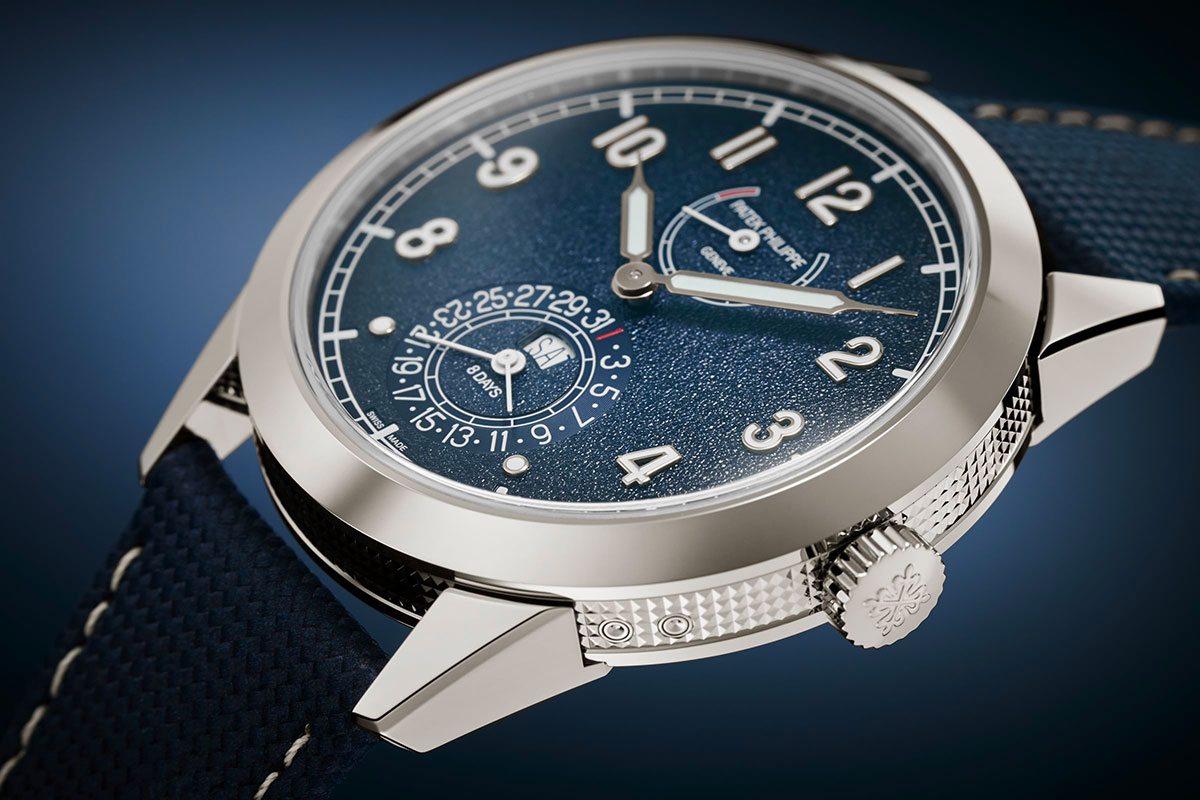
    This is probably because Patek Philippe has been reworking the design of the Calatrava collection subtly and intelligently over the past few years. The aim is to ensure that it does not become mired in tradition and lose its relevance, while still maintaining its identity. Examples of this include the expansion of dial finishes, more pronounced shapes (particularly in the lugs), and the use of the Clous de Paris finish along the case middle.

    All these elements are present and well amalgamated in the Calatrava 8-day ref. 5328G. This proves that the Geneva-based Maison has no intention of standing still with this collection — quite the contrary. In order to update the collection and make it more appealing to new enthusiasts, Patek Philippe incorporates technical solutions and design elements from its past without hesitation. In this case, it is the eight-day power reserve.

    The autonomy of the Patek Philippe calibres

    This long autonomy is a feature already found in some perpetual calendar table clocks from the 1920s, which were equipped with an eight-day power reserve. More recently, the Maison produced the Ref. 5100 10 Days, introduced in 2000. This model features a rectangular case and was produced in limited quantities of three thousand. This was the world’s first chronometer wristwatch with a 240-hour power reserve.

    Another example is the Ref. 5101P 10 Days Tourbillon, released in 2003, is a platinum timepiece with an Art Deco-inspired rectangular case and a bespoke hand-wound movement. Ten years later came the Ref. 5200 Gondolo 8 Days, Day & Date Indication. Its rectangular, hand-wound calibre and instantaneous weekday and date changes bear close relation to the reference I am writing about today. We shall see later.

    I recognise this face…

    I’m reminded of the feeling I wrote about previously when looking at that field watch. This feeling mainly comes from the structure of the dial. As with all my articles, I prefer to leave the strictly technical details to the captions. However, I think it is necessary to mention here that the Calatrava 8-day ref. 5328G looks like.

    The smoky blue dial features an asphalt-like texture, a familiar sight for Patek Philippe enthusiasts. We first saw this texture on a brown dial in ref. 5226G, introduced in 2022. Alongside this finish, the Calatrava 8-day ref. 5328G retains the design of the syringe hands and Arabic numerals from its predecessor, giving it the serious appearance of a field watch. Robustness and clarity of information reading are essential characteristics of this type of watch. For this reason, I think the dial is well designed.

    Eight carefree days!

    However, I mustn’t forget that a field watch should also be reliable and autonomous. With this in mind, before we return to the technical specifications, I would like to mention a historical detail regarding the calibre of the Calatrava 8 Days Ref. 5328G.

    As is often the case with Patek Philippe movements, it has a code that is almost impossible to remember – 31-505 8J PS IRM CI J – but it has solid roots in the company’s past. In fact, it relates to the Ref. 5200 Gondolo 8 Days, Day & Date Indication that I wrote about above, as they share the same basic movement structure. The main difference is that the 28-20 REC 8J PS IRM C J calibre was rectangular, to match the shape of the case. The current one is round, to fit perfectly into the Calatrava-style case.

    The eight-day autonomy is indicated by the ‘8J’ in the movement’s name and includes the functional features typically expected from a Patek Philippe field watch. These include the instantaneous change of the day of the week and the month, as well as the power reserve, which formally lasts eight days, but in reality lasts nine. This extra day is indicated by a red zone on the autonomy indicator.

    An 8-day Calatrava for all days

    Now, let’s move on to the captions. Not before recalling the price of the Calatrava 8-Day Ref. 5328G – €71,280 – and making a few final remarks about the watch. Patek Philippe unveiled it at Watches and Wonders alongside another Calatrava reference, the 6169P, which has a platinum case and an elegant, classic design. In my opinion, this was a smart move.

    While the platinum watch is undoubtedly a dress watch, more suited to special occasions than everyday wear, the Calatrava 8-Day Ref. 5328G is the perfect everyday watch. You can rely on it to keep the correct time and date when you put it on your wrist, even if you only wear it a few days a week. In this way, the Maison has offered an alternative within the same collection to satisfy the different tastes and needs of enthusiasts. Without altering it, as I wrote in the opening lines. This is why the Calatrava 8-day ref. 5328G is one of the few haute horlogerie pieces that is more than the sum of its parts today. In this respect, it is very Patek Philippe.