
Giornale Degli Orologi
Menu
Menu

Tag: Richard Mille

  • RM 30-01 Le Mans Classic: Richard Mille goes running

    RM 30-01 Le Mans Classic: Richard Mille goes running

    When the Le Mans Classic arrives, so does Richard Mille. It’s as certain as flowers in spring, paying taxes and receiving presents at Christmas. And when Richard Mille approaches the race, a limited-edition watch follows. For the twelfth edition of the competition, which will take place from 3 to 6 July 2025, the brand has created the RM 30-01 Le Mans Classic, with only 150 pieces available. This tradition stems from the brand’s founder’s love of engines, regardless of their nature, age or power. The partnership began with the race in 2002 and, with the RM 30-01 Le Mans Classic, continues into 2025 with a watch that embodies sportiness in its purest form.

    The Le Mans Classic

    To put the collection into a motorsport context, the Le Mans Classic features cars that have made history in one of the most famous endurance races, alongside the 24 Hours of Daytona. Built between 1923 and the 2000s, the cars compete in six different categories over 24 hours, representing the major motoring eras that characterised the 24 Hours of Le Mans from 1923 to 1981.

    The race starts at 4 p.m., with around 1,000 drivers competing, and on competition days, the city of Le Mans sees its 150,000 inhabitants joined by tens of thousands of fans and spectators. Starting with 30,000 attendees in the first edition, this figure has grown to over 235,000 in 2023. It is easy to see why this event is unique for Richard Mille and its RM 30-01, dedicated to the race, in terms of the passion it unleashes and the visibility it offers the brand.

    The RM 30-01 Le Mans Classic case

    But, since we are Giornale degli Orologi, a watch magazine and not a motoring newspaper, let’s get down to business. As I wrote earlier, the RM 30-01 Le Mans Classic fits into a category that has recently produced references such as the RM 72-01 and the RM 029. The latter was created for an edition that was cancelled due to the pandemic (that of 2021); the RM 72-01 was released in 2023. The first Le Mans Classic came in 2008.

    Today, therefore, it is the RM 30-01 Le Mans Classic that steals the show. It is a watch with an aesthetic that will be familiar to all fans of Richard Mille and haute horlogerie. I will give you a brief introduction here, letting the captions and, above all, the pictures speak for themselves — they deserve it.

    As always with this brand, the case has important dimensions. With its classic tonneau shape, it measures 42 x 49.94 x 17.59 mm. Despite its size, it remains proverbially light on the wrist thanks to the combination of Quartz TPT and grade 5 titanium that make it up — a material synonymous with comfort and high resistance. The colour of the Quartz TPT is British Racing Green, which is also found in the other two Le Mans Classic watches. This colour is inspired by British sports cars of the last century, as the name suggests.

    Information and legibility

    As is often the case with Richard Mille’s racing-inspired watches, the RM 30-01’s skeletonised dial is packed with information that remains legible despite the apertures. The most notable features are the 24-hour counter and the date window at 2 and 4 o’clock. The former is not just a GMT; it plays on the 24-hour concept evoked by the Le Mans race. If the wearer wants to time the endurance event, it could not be easier. The date window, on the other hand, is oversized and framed by a chequered flag. Tens and units are clearly visible through the pierced discs.

    Other legible details include the distinctive design of the central residual range indicator and two indicators. The first one signals the engagement or disengagement of the movement’s clutch. The other one lets the wearer of the RM 30-01 Le Mans Classic know whether the automatic winding is engaged. This is related to the function selector on the crown.

    The RM 30-01: at the heart of the movement

    The RMAR2 calibre, specially modified to include a 24-hour counter, is the heart of the watch. This self-winding movement vibrates at a rate of 28,800 times per hour and has a power reserve of 55 hours. The movement is equipped with a free-sprung balance with variable inertia. This type of balance guarantees greater reliability in the event of shocks, particularly during assembly and maintenance operations. Its design eliminates the need for a regulating paddle: four small, swivelling, eccentric masses attached directly to the balance allow for more accurate calibration.

    However, the calibre’s most distinctive feature is its declutchable variable geometry rotor. This represents a significant advance in design and miniaturisation, presenting an extraordinary technical challenge for Richard Mille. Essentially, an automatic watch is wound through a small rotor. Its cyclical movement supplies energy to the winding barrel, which reaches optimum tension when fully wound.

    However, after this point, it is easy for excess tension to occur due to excessive winding. This must be avoided to prevent damage to the movement. Traditionally, this is achieved using a sliding flange that allows the spring to slide and prevents excessive tension on the movement. Unfortunately, this traditional system can allow harmful debris to accumulate inside the calibre. This is caused by the flange pressing against the inside of the barrel for too long, particularly if the wearer is very active.

    To avoid such adverse conditions, Richard Mille’s detachable rotor automatically disconnects from the barrel once the mainspring is fully wound. These phases can be controlled thanks to the clutch engagement indicator, which is located in the upper left-hand corner of the dial. It informs the user whether the rotor is engaging (on) or disengaging (off).

    Working on passion

    sThe watch’s green strap is made of perforated rubber and features a design reminiscent of sports car air intakes. In short, the RM 30-01 LMC oozes speed. Why? The Le Mans race is legendary among motorsport enthusiasts. Richard Mille is widely regarded as one of the greatest watchmakers of the 21st century. To say that this combination is apt is perhaps an understatement.

    As with all the watches produced by this atelier, the RM 30-01 Le Mans Classic comes with a hefty price tag. It’s similar to the cars you see on the French circuit. 220,000 Swiss francs, not including tax.
    The fact that there are few pieces in circulation increases not so much the economic value of the watch as its desirability. It’s the feeling driving the enthusiast in whatever field that passion is expressed.
    Bravo to Richard Mille, who has grasped this concept as well as other brands but perhaps manages to translate it into watches more effectively. Chapeau.

  • RM 75-01 Flying Tourbillon Sapphire: Richard Mille is crystal clear

    RM 75-01 Flying Tourbillon Sapphire: Richard Mille is crystal clear

    If the great 17th century French philosopher and writer François de La Rochefoucauld were alive today, he might well be wearing a Richard Mille watch. Perhaps the RM 75-01 Flying Tourbillon Sapphire, the brand’s latest model. After all, as he wrote in one of his most famous aphorisms, ‘The only thing that should surprise us is that there are still some things that can surprise us’. This is precisely how I felt when I saw the initial images of this new watch − unfortunately, only those for now. I was astonished.

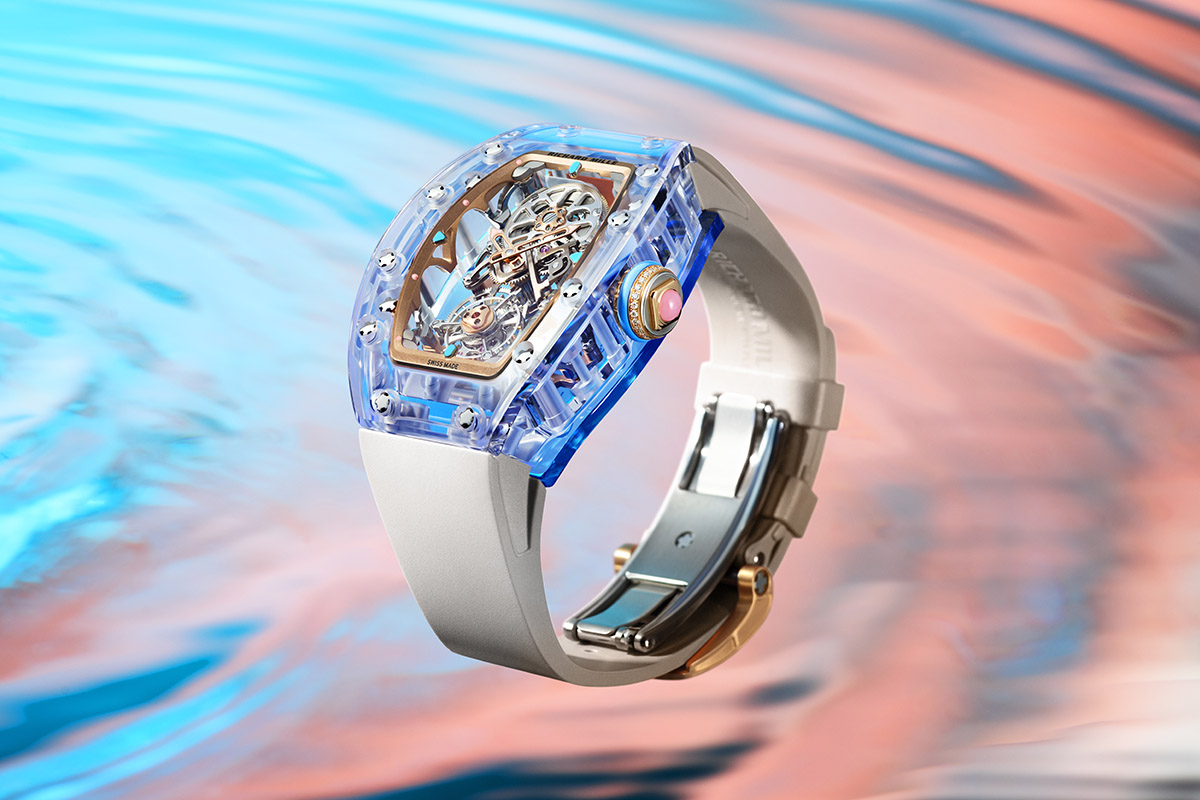
    Above all, I was astonished by the brand’s ability to continually master the most advanced materials in watch manufacturing: Quartz TPT, carbon TPT, ceramic, gold, titanium and, of course, sapphire. Richard Mille’s ability to shape these materials, ranging from ‘simple’ to composite, establishes the brand as one of the most advanced in this field. The RM 75-01 Flying Tourbillon Sapphire is further proof of this, particularly for those familiar with working with sapphire.

    Lords of Sapphire

    Essentially, it involves operating on the edge of masochism. The sapphire used for watch cases, like the RM 75-01 Flying Tourbillon Sapphire, is a synthetic material produced in a laboratory. Technically, it is synthetic corundum, which is notable not so much for its transparency as for its hardness, which is surpassed only by that of a diamond.

    This article explains the process of machining such a hard and resistant material. Over 10 years ago, Richard Mille became the first brand to use this material for watch cases. That was in 2012, which feels like a geological era ago. Consider what has happened to the watch market in the meantime, from the pandemic to the explosion and subsequent implosion in China − just two key episodes.

    The RM 75-01 Flying Tourbillon Sapphire continues this legacy and takes excellence even further. The 2012 watch combined two of the most highly regarded complications: a split-seconds chronograph and a tourbillon. This model “limits” itself to a flying tourbillon. However, materials science and calibre technology have evolved at an incredible speed in the intervening 13 years. Richard Mille has kept pace, needless to say.

    The colours of the RM 75-01 Flying Tourbillon Sapphire

    With that in mind, let me introduce today’s watch. There are actually three versions, as the brand has worked with three different colours of sapphire. More specifically, the sapphire back is available in three versions: completely transparent, blue and lilac-pink. There are several possible reasons for limiting the colour to the case back.

    Undoubtedly, creating a fully coloured sapphire case is complex. Minerals must be added to the basic corundum to give the material the desired colour: titanium and iron for blue, for example. Needless to say, achieving the desired shade by finding the right proportion of additives is not easy. Richard Mille certainly does not compromise on quality. However, if a ‘cheap’ solution can be found in terms of cost and processing time, why not use it?

    Another possible reason is ‘scenographic’: an entirely coloured sapphire case could distract from the calibre, the real protagonist of the watch’s design. However, more prosaically, I believe that the choice of a coloured case back was made because, despite being only part of the watch and located at the rear, its transparency captures nuances and virtually colours it as well.

    This would be an intelligent way to achieve a high-quality result while reducing the effort involved in the challenging production of coloured sapphire. It is no coincidence that only 15 pieces of the fully transparent version are manufactured, while the blue and lilac pink versions are limited to 10 due to obvious production difficulties.

    The RM75-01 calibre finish

    I will now move on to the movement. This is the hand-wound RM75-01 calibre, featuring a flying tourbillon and an hour and minute display. There are no additional complications, counters or function selectors. It would appear minimalist were it not a Richard Mille. While I will leave most of the technical details to the captions, it is worth emphasising here that the movement is distinguished not only by its mechanical complexity, but also by its very high level of refinement.

    The chamfers, locking elements and contact surfaces are hand-polished, as are the pivots. To achieve the micro-peened effect of the milling, Richard Mille used sapphire microspheres. The steel parts have also been sandblasted using sapphire microspheres (the mainplate and bridges are made of titanium) and have polished sides.

    As with all the brand’s movements, great care was taken when manufacturing the geared wheels of the RM75-01 calibre. Their concave bevels were made using custom-made diamond tools to achieve micron-level precision. The faces of the wheels have a circular satin finish and are rhodium-plated before the gearing is made, to eliminate any defects or imperfections. The wheels undergo minimal corrections; any alteration to their geometry would compromise the performance of the time train.

    Richard Mille DNA

    In the press kit for the RM 75-01 Flying Tourbillon Sapphire, the brand describes the watch as “…embodying a metaphysical balance. The modernity and technical sophistication of its sculptural calibre harmonise with a timeless inspiration drawn from historical architecture and the softness of the oceans — a duality that perfectly reflects the brand’s artistic and technical approach, where diverse worlds converge to open new creative horizons“.

    I will grant the authors some poetic licence. After all, marketing is neither about technique nor passion. In this sense, the focus on colour nuances inspired by the shades of the sea is fitting. However, we must not forget that this is primarily a mechanical watch, an achievement made all the more impressive by the fact that it combines a complex architectural structure with the basic function of displaying the hours and minutes, enhanced by the flying tourbillon.

    Given the commitment to materials, technology, research and development that the Manufacture has invested in the watch, the price tag of around 2 million Swiss francs is entirely predictable. As I mentioned at the beginning, this is something one should no longer be surprised by. Richard Mille embodies innovation, mechanical avant-garde and materials science, as well as an obsession with research. All of this comes at a cost commensurate with the quality of the final product, and the RM 75-01 Flying Tourbillon Sapphire is no exception. Excellence and perfection have never been for everyone.

  • RM 43-01 Tourbillon Split-Seconds: a Richard Mille body, a Ferrari soul

    RM 43-01 Tourbillon Split-Seconds: a Richard Mille body, a Ferrari soul

    Last week, Richard Mille launched the second watch created in collaboration with Ferrari: the RM 43-01 Tourbillon Split-Seconds Chronograph Ferrari. I was privileged to be invited to its unveiling during a major international event in Paris. The three-day event was full of top-level experiences, the highlight of which was undoubtedly the presentation of the new watch. Or, more precisely, two new pieces, since the collection consists of one model made from titanium and Carbon TPT and another made entirely from Carbon TPT.

    Let me start by saying this. In this article, I will not discuss the technical details of the watch in depth; I will cover these later. Given its characteristics, it is worth taking a little time to understand and appreciate it. However, from an editorial perspective, it would be unreasonable to wait any longer to discuss the RM 43-01 Tourbillon Split-Seconds Chronograph Ferrari.

    So, while I was in Paris, I took full advantage of the opportunity to see, touch and wear the watch, and to hear first-hand from those who witnessed its creation. The key figures at Richard Mille and Ferrari were present. Among them Richard’s children, Amanda and Alexandre Mille, who now hold the positions of Brand and Partnerships Director and Sales Director respectively. I also met Tim Malachard (Marketing Director), Salvador Arbona (Technical Movement Director) and Maxime Guenat (Operations Director). Of the Ferrari managers I met, there was Gianfranco Saracino, Partnership Design Manager at the Ferrari Design Centre, and Francesca Vernia, Head of Licensing and Partnerships at Ferrari.

    A very Richard Mille watch

    The collaboration between Richard Mille and Ferrari began with initial discussions in 2020, resulting in the launch of the partnership the following year. In 2022, as I’m sure you’ll recall, this culminated in the incredible RM UP-01. Considering that watch was neither particularly reminiscent of Richard Mille nor Ferrari, I expected to find myself with a very ‘Prancing Horse’ watch in my hands when I went to the event in Paris. Those with a good memory will recall that it reflects the philosophy of the 2021 RM 40-01 McLaren Speedtail. This piece has a teardrop-shaped case that mirrors the bodywork of the British supercar of the same name.

    Neither of the above. The RM 43-01 Tourbillon Split-Seconds Chronograph Ferrari is unmistakably a Richard Mille. The influence of the Ferrari Design Centre is more apparent in the details than in the overall architecture. Alexandre Mille confirmed this when he told us that «the UP-01 was outside the box in terms of what people expected from our collaboration with Ferrari. In a way, the RM 43-01 Tourbillon Split-Seconds Chronograph is more classic in design and embodies the racing watch we always dreamed of creating with the Prancing Horse».

    Improving the case’s aerodynamics

    Saracino also emphasised that attention to detail is the key to Ferrari’s aesthetic appeal. He said: «We tried to create a fluid and aerodynamic design. Even the bezel sits lower on the case than in previous models. The buttons’ shape is directly inspired by the rear lights of the Ferrari SF90 Stradale. These lights demonstrate the balance between tradition and innovation, as well as the modernisation of design codes sought by Flavio Manzoni, Ferrari’s Design Director since 2010».
    However, to improve the case’s aerodynamics, the ‘pillars’ – a hallmark of Richard Mille designs – had to be removed from the middle.

    The inspiration behind the RM 43-01 Tourbillon Split-Seconds Chronograph

    As a watch designed for speed, the RM 43-01 naturally features a split-seconds chronograph complication. As Salvador Arbona reminded us: «The split-seconds chronograph fits naturally into the world of motor racing. It allows you to stop one hand to measure an intermediate time, which is ideal for recording lap times on the track».
    To help us better understand the technology behind the watch, Richard Mille created 1:18 scale working replicas of key sections for the presentation. Models of the tourbillon, of split-seconds mechanism, and of the power reserve indicator were shown.

    After all, the RM43-01 calibre was developed in collaboration with Richard Mille’s long-standing partner, Audemars Piguet Le Locle (APLL). This latest model continues the brand’s tradition of split-seconds chronographs. The list includes the RM 008 from 2003, the RM 50 from 2012, the RM 50-02 from 2018 and the RM 50-04 from 2019. Arbona reminded us that, compared to the base movement, «we changed the position of the elements to achieve a harmony inspired by Ferrari engines and Richard Mille. We moved the tourbillon to 5 o’clock – an unusual choice – to create a movement that evokes the design of an engine».

    This freed up a significant amount of space at 7 o’clock that needed to be filled. This was achieved by inserting a floating element engraved with the Prancing Horse. A design inspired by the wing support shape of the Ferrari 499P ‒ «the one that won twice at Le Mans», as Gianfranco Saracino remarked. Along with the red and yellow accents on the chronograph hands, this is the only feature that instantly evokes the heritage of Maranello racing cars.

    RM 43-01: Prices and availability

    As mentioned above, I would prefer to omit the technical details for now. I can devote a separate article to the watch at a later date. For now, I will leave you with the prices, which are unmistakably Richard Mille. The titanium and Carbon TPT version costs 1,150,000 Swiss francs, while the Carbon TPT version costs 1,350,000 Swiss francs. Although these prices are lower than those of the RM UP-01, which cost around 1.5 million Swiss francs, they are still significant. There are 75 pieces of each variant in the limited edition, of which around 30 are already available.

    “It’s never the price that dictates what we do. For us, innovation always comes first, without compromise’, Maxime Guenat told us. He also hinted that the next creations to arise from the collaboration with Ferrari will be equally unexpected. We believe him.