Giornale Degli Orologi
Menu
Menu

Tag: Diver watch

  • Seastar 38 mm: Tissot’s chrono diver becomes compact

    Seastar 38 mm: Tissot’s chrono diver becomes compact

    Tissot‘s history and range of products speak of an eclectic brand, capable of covering all areas of watchmaking with its collections, from sports chronographs to dress watches and divers’ watches. The latter category flourishes again in summer, as demonstrated by the new Seastar 38 mm chronograph recently presented. Tissot has a long-standing tradition in the field of diver’s watches: certainly, this collection, which today inaugurates a new case size, is a perfect example of the brand’s current success in this area.

    Since the 1930s

    The Tissot Seastar 38 mm chronograph is the heir to a rich history dating back to the 1950s. However, its roots can be traced back to the 1930s, when the Manufacture collaborated with the Swiss Watch Research Laboratory in Neuchâtel to conduct a large number of experiments. These experiments aimed to create waterproof watches.

    The first water-resistant models to emerge from this work were the Camping (1938) and the Aquasport (1939). As well as being waterproof and antimagnetic, they were also shockproof and dustproof, and had a stainless steel case and shatterproof glass.

    In the 1940s, Tissot launched the new Five Star collection in Canada, which also benefited from these innovations. A decade later, an improved model of the hermetically sealed, waterproof watch was created and was named the Seastar. The name was registered in 1952, and the watch has since become an iconic model for the brand.

    From the Seastar T12 to the Seastar 38 mm

    The Seastar collection of diver’s watches has enjoyed great success, offering models for both men and women. The most recent example is the Seastar 38 mm. From the outset, the Seastar was the go-to watch for sports and diving enthusiasts, and the collection has grown over the years. First, the 1956 Seastar T12, which was guaranteed to a depth of 12 atmospheres and was released to coincide with the premiere of Jacques-Yves Cousteau‘s film The Silent World. Moreover, it was also worn by Darjeeling Himalayan Mountaineering Institute instructor Nawang Gombu during his ascent of Everest in 1963.

    Before and after that ascent, other Seastar T12s were worn by mountaineers climbing the peaks of the Andes and the Himalayas, who used them to test their resistance to extreme conditions. Over the years, the collection has grown to include models such as the Seastar Seven, which has a slimmer case thanks to a new monocoque system for which a patent was filed in 1963. Another notable addition was the Seastar Quartz of 1978, featuring a quartz movement that was undoubtedly ahead of its time.

    High-performance quartz

    Year after year, we have finally arrived at the Seastar 38 mm, which completes the chronograph case size range of the collection. Previously, lovers of this type of watch within the Tissot catalogue could only choose from chronographs with 45.5 mm cases, which as a matter of fact ruled out men with small wrists and women.

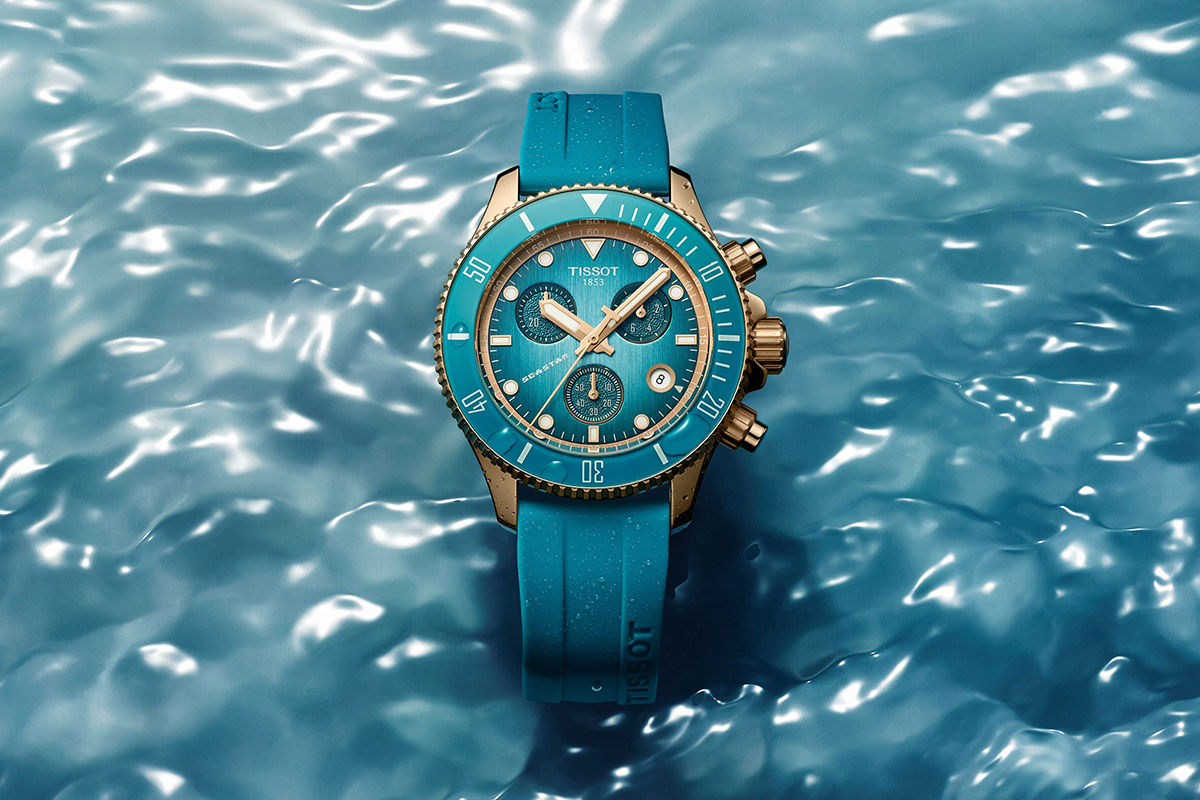
    The new Seastar 38 mm is aimed at these two groups of enthusiasts in particular. It does so not only with the new diameter, but also by offering a choice of six different models. All of the new watches in the collection are powered by a Swiss-made quartz calibre. It is an ETA Fashionline G10.212 AB PowerDrive: a two-pusher chronograph movement featuring hours, minutes and a small seconds display at 6 o’clock, as well as a date display.

    The movement is equipped with 1/10th of a second and 30-minute counters, as well as the so-called EOL (end of life) function. This means that when the battery is about to run out, the seconds hand moves in slower jerks to signal that the battery needs replacing.

    Seastar 38 mm: colour and performance

    Of the six Seastar 38 mm references, four have dark dials, one has a light dial and the sixth has a new, summery shade. Tissot refers to this colour as ‘petrol green’. With its rose gold PVD steel case, bezel and matching silicone strap, it creates a very pleasing and decidedly summery combination.

    This is similar to the version with a silver dial, white bezel and strap, and a steel case. The references with dark dials have a more serious and ‘professional’ look: two have a black Pvd-treated case and two have a steel case and bracelet. Of these, one has yellow gold Pvd details that add a touch of luxury to the sporty design. Of the two watches with black Pvd cases, one has a matching bracelet and the other has a matching silicone strap.

    The price tag is in line with what we would expect for a quartz chronograph in Tissot’s Seastar collection. Prices range from 645 euro for the steel/gold and black Pvd bracelet versions, to 545 euro for the white reference. In between, one finds 595 euro for the petrol green and 575 euro for the black Pvd chronograph with a strap or an all-steel bracelet.

    As Tissot says, the new Seastar 38 mm is ‘designed for those who move like water, calmly on the surface and powerfully beneath it’. It is also ideal for those looking for a reliable and reasonably priced alternative to the many improvised divers that appear around summertime. After all, 73 years of Seastar is more than a guarantee.
  • The Deep Diver: Girard-Perregaux’s vintage diver returns

    The Deep Diver: Girard-Perregaux’s vintage diver returns

    There are watch brands all over the world that don’t receive the recognition they deserve. This strikes me every time I scroll through posts on major watchmaking forums or browse the many Facebook groups dedicated to the subject. Perhaps it’s due to trends, marketing campaigns or communication strategies. What I notice is that some of the names that have truly shaped the history of watchmaking still remain in the shadows. Girard-Perregaux is one of them. It doesn’t take much to realise that it deserves more recognition. Just look at its current collections, the extraordinary complications found in some models, the quality of the materials used, and how some designs have remained popular for centuries. Centuries indeed. Headquartered in La Chaux-de-Fonds (the cradle of Swiss watchmaking) since 1856, Girard-Perregaux actually dates back to 1791. Today, I’m here to talk about its latest release: the Deep Diver, a diving watch (or sports watch, more broadly).

    Timeless Icons

    Girard-Perregaux was created by the unforgettable Gino Macaluso in the early 1990s and is currently owned by the SoWind Group. In 2008, it was acquired by the French luxury giant Kering Group. Then, in 2022, it was bought out by its own management (as was Ulysse Nardin), returning it to full independence. Under the leadership of Patrick Pruniaux, the brand’s classic timepieces have been modernised while remaining faithful to their origins and unmistakable design heritage.

    Take the current Laureato, for example. First introduced in 1975, this sporty model was named after The Graduate, starring a young Dustin Hoffman, and helped to broaden the brand’s appeal. Over the past decade, it has been offered in a wide range of models, bolstered by prestigious partnerships such as the one with Aston Martin.

    Then there’s the Casquette 2.0: an electronic timepiece with an unusual design that stays true to the original from 1976. Then there’s the evergreen La Esmeralda, which has astonished watch lovers since 1867 with its tourbillon beneath three golden bridges (“Sous Trois Points d’Or”) – and is now also available in other materials. Finally, we come to the subject of this article: the Deep Diver, a modern reinterpretation of a 1969 icon.

    The Girard-Perregaux Deep Diver: limited to just 350 pieces

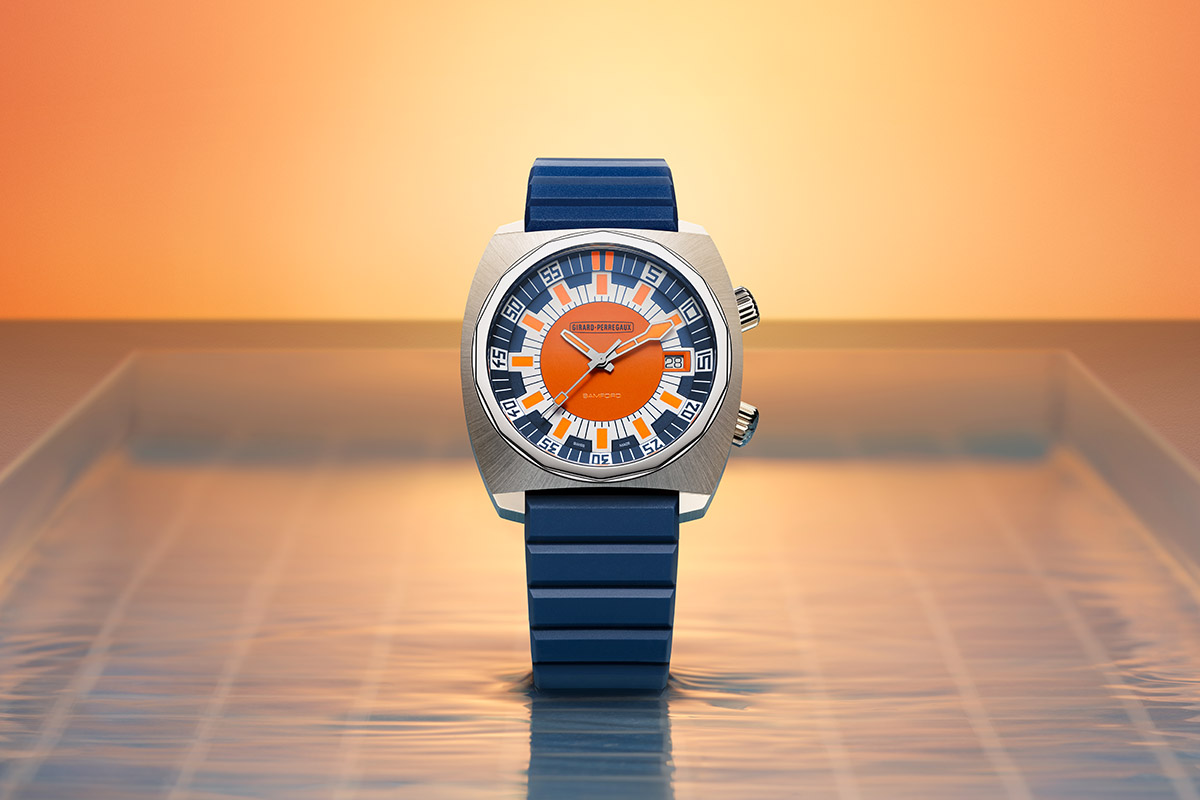
    Like the other models in the Legacy Edition line, the Deep Diver is a limited edition. Only 350 pieces have been produced, each one individually numbered, which makes it particularly appealing to collectors. Its design remains faithful to that of the original model, the reference 9108. It features a cushion-shaped titanium case, a 14-sided bezel and impressive water resistance. The updated version is water-resistant up to 20 ATM.

    As the name suggests, it is a true dive watch and is equally suitable for wear outside the water. Proof of this lies in the rotating inner ring, which is controlled by the crown at 2 o’clock. This acts like a bi-directional rotating bezel. With a scale from 0 to 60, the “0” marker on the minute hand can be set to measure elapsed time from any given moment.

    It is operated by a screw-down crown, making it highly secure and immune to accidental movement — bumps or unintended touches won’t alter its position. For more design details of the Deep Diver’s dial, please refer to the photo captions in the gallery.

    The Bamford Watch Department Collaboration

    At the centre of the dial, just below the hand axis at 6 o’clock, you’ll notice an orange ‘Bamford’ inscription. This is not the usual movement type or jewel count (27, in this case), but rather the name of a renowned customisation house. Watch enthusiasts will recognise it as the Bamford Watch Department: a London-based firm founded in 2007 that specialises in bespoke timepieces.

    Despite its relatively recent origins, Bamford has forged top-tier partnerships in the luxury segment. As well as designing this Deep Diver, Bamford has collaborated with Franck Muller, Zenith, TAG Heuer, Chopard and Bremont. For Girard-Perregaux, it has also personalised a piece from the Cat’s Eye women’s collection.

    The Original Deep Diver’s Gyromatic Movement

    The modern Deep Diver is powered by the GP03300 in-house movement, which is also found in the time-only models of the Laureato collection. It is therefore not the same as the original from 1969. Technology and materials have evolved significantly in nearly 60 years. Nevertheless, the original Gyromatic movement deserves a mention.

    The term ‘Gyromatic’ did not refer to a single calibre, but to a family of movements produced by Girard-Perregaux from the 1950s to the 1970s. These were known for their bi-directional winding rotors. Initially, these were in-house modules mounted on base manual calibres (A.S., ETA or Peseux). Over time, ‘Gyromatic’ came to represent all of the Maison’s automatic movements, including integrated ones.

    In simple terms, the module consisted of a rotor and a system of reversing gears connected to the mainspring barrel via a pair of free wheels with coaxial pinions. Instead of the more delicate conventional pawls, it used seven ruby rollers, or Gyrotrons, per wheel. As the oscillating weight moved in either direction, one of the wheels would engage and wind the mainspring.

    Around 1966, Gyromatic technology evolved to incorporate high-frequency movements, reaching 36,000 vibrations per hour. This frequency ensured superb accuracy and reliability, then as now. The high-frequency ticking also gave the seconds hand a smooth, continuous sweep. This is a feature that is highly appreciated by micro-mechanics purists. These Gyromatic HF models are now highly sought-after by collectors.

    The New Deep Diver features the GP03300 Caliber

    Returning to the modern Deep Diver, the GP03300 features an in-house movement with a balance wheel that beats at 28,800 vibrations per hour (4 Hz). It has a standard power reserve of 46 hours, just under two days. The movement can be viewed through a blue-tinted sapphire porthole on the case back.

    I use the word ‘porthole’ intentionally – it’s not a typical wide, transparent case back offering an open view. Instead, Girard-Perregaux offers a central sapphire medallion with a metallic blue tint. The trident emblem, wave pattern and curved ‘Deep Diver’ inscription also partially obscure the view.

    You might think that the Côtes de Genève decoration on the oscillating weight and bridges deserves a clearer view. Fair enough, but historical fidelity takes precedence. The 1969 model had a solid steel case back decorated with the same trident, waves and text. Transparent case backs were uncommon back then, and sometimes even frowned upon. The trend of showcasing movements is a relatively recent phenomenon, and is often unnecessary, though not in this case.

    Price and Wearability

    The Girard-Perregaux Deep Diver is priced at €16,000 in Italy and comes with a second orange rubber strap and a titanium buckle. This is comparable to the entry-level Laureato with a steel bracelet. The two watches share the same movement, sporty yet elegant styling, and comfortable fit. Girard-Perregaux designed this watch for everyday wear, and it is also suitable for smart-casual settings.

    Given the current fashion for pairing sneakers with formal wear, you won’t look out of place wearing the Deep Diver in relaxed yet stylish work environments. Plus, the two interchangeable rubber straps – blue and orange – let you switch things up. With its modest case size of 40.3 x 38 mm and vibrant colour, the watch could even look great on a woman’s wrist.